.svg)

Medicines, logistics and supply chain management
Donated medicines are only worth anything once they are on a shelf in the right hospital. Between the aircraft and the patient there are six steps, and this consignment documents each one.
Worked example
Hope Rises International consignmentMay 2025
Air waybill
074 ATL 02341765Tracked from arrival to distribution
Facilities supplied
14 mission health facilitiesAcross seven states
Delivery window
23 May to 2 June 2025In RedAid Nigeria’s own vehicles
Six steps, each with a document behind it.
Supply chain failures in donated medicine are rarely dramatic. They look like a carton that was counted twice, a batch that expired in a store room, or a hospital that received three months of one drug and none of another. The discipline that prevents this is documentation at every handover, and it is the part of the work nobody photographs.
| Stage | What happens |
|---|---|
| Receipt | Consignment arrives from Hope Rises International against air waybill 074 ATL 02341765. |
| Inspection | Customs, NAHCO and NDLEA inspect on arrival in Abuja, with clearing agent Timeline Logistics and Supply Chain Solutions. |
| Verification | Quantities are cross-checked against the Hope Rises packing list on arrival at Enugu. |
| Quality check | Physical inspection of the stock: condition, packaging, batch and expiry. |
| Storage | Documented and stored in the RedAid Nigeria warehouse in Enugu. |
| Distribution | Delivered in RedAid Nigeria’s own vehicles against a plan agreed with the programme team, 23 May to 2 June 2025. |
Three agencies inspect before anything moves.
A donated consignment entering Nigeria is examined by Customs, the Nigerian Aviation Handling Company and the National Drug Law Enforcement Agency. Each has its own reason to look inside the cartons and its own paperwork. Getting this wrong does not produce a delay of hours; it produces a consignment sitting at an airport while a clinic runs out of stock, and in the case of medicines, a cold-chain question about whether the stock is still usable.
The 2025 consignment cleared through a named agent and was inspected on arrival rather than after storage, which is the sequence that makes a discrepancy attributable to a specific handover.
Donated stock let supported mission facilities treat indigent patients free of charge and widen their service coverage.
Who gets what is decided by patient load, not by who asked first.
Allocation is where a supply chain either serves patients or serves relationships. The stated basis for the May 2025 distribution was patient load at each facility, agreed with the programme team in advance of the delivery run rather than negotiated at each hospital gate.
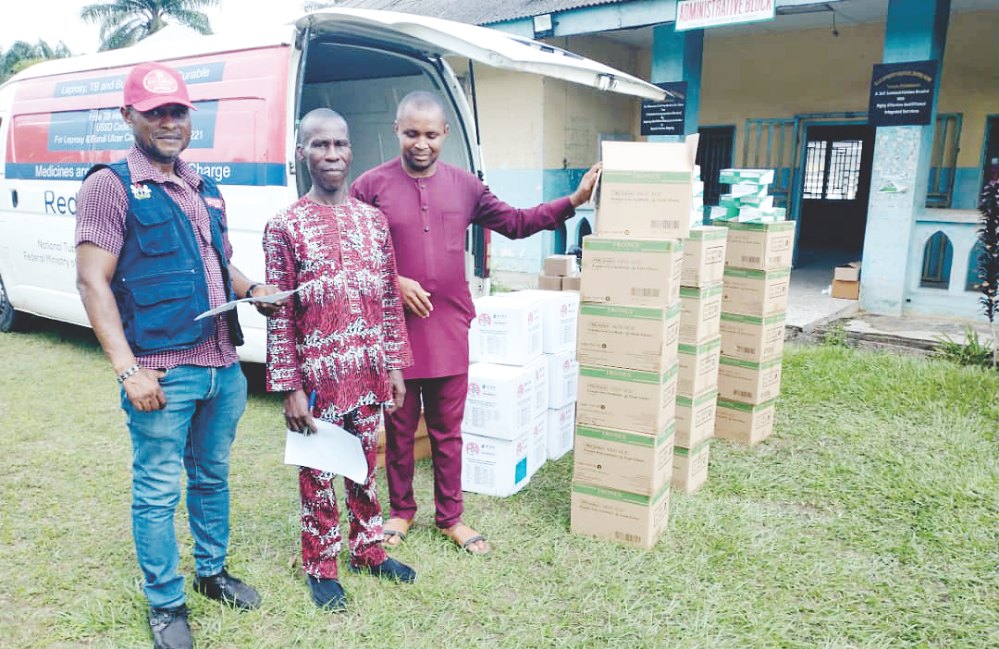
Delivery used RedAid Nigeria’s own vehicles. That is a small detail with a large consequence: it removes the dependence on hired transport, which is the step most likely to fail silently when a route is long, the road is bad, or a vehicle is unavailable on the day.
-
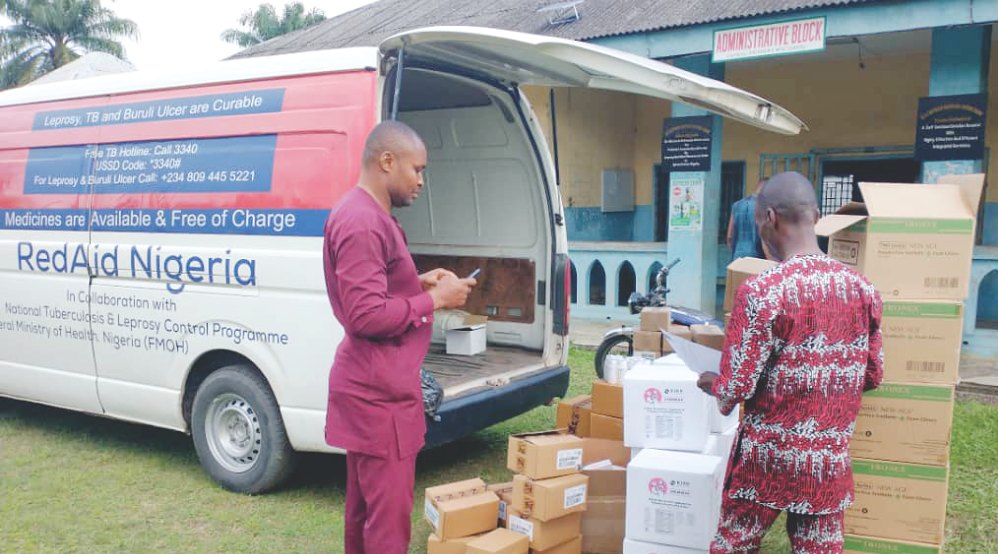
Warehouse handling in Enugu. Report, logistics chapter. -
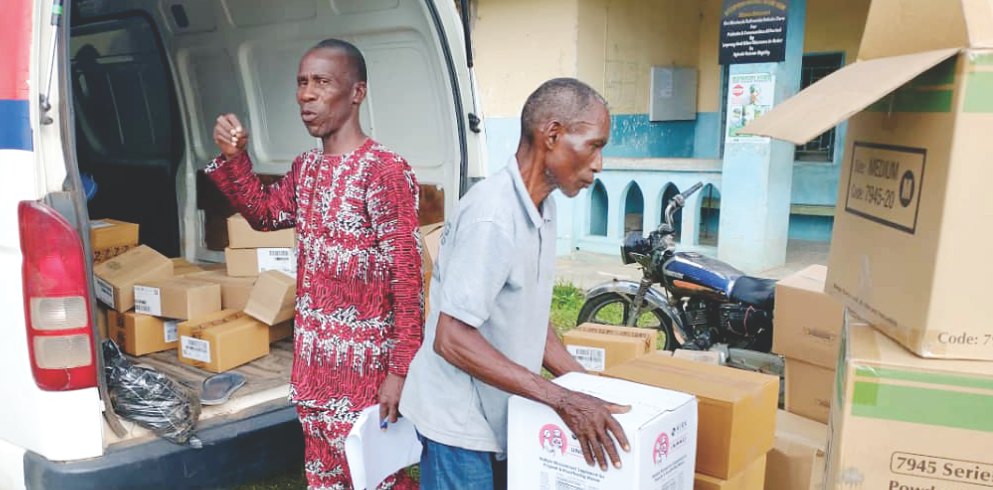
Delivery to a mission facility. Report, logistics chapter.
Fourteen hospitals, mostly mission-run, mostly rural.
These are the facilities that received stock from the May 2025 consignment. Most are mission hospitals serving communities that have no other provider within reasonable distance.
| # | Facility |
|---|---|
| 01 | St Patrick Hospital, Mile 4 Abakaliki |
| 02 | St Joseph Hospital, Adazi |
| 03 | St Benedict Hospital, Ogoja |
| 04 | Regina Caeli Hospital, Awka |
| 05 | St Joseph Hospital, Asaba |
| 06 | Bishop Shanahan Hospital, Nsukka |
| 07 | Annunciation Hospital, Enugu |
| 08 | Good Shepherd Hospital, Enugu |
| 09 | Presbyterian Hospital, Uburu |
| 10 | Daughters of Mary Mother of Mercy Hospital, Ahieke Umuahia |
| 11 | Qua Iboe Church Hospital, Ekpenebom |
| 12 | St Charles Borromeo Hospital, Onitsha |
| 13 | Iyienu Hospital, Ogidi |
| 14 | Joint Hospital, Achi |
The same machinery carries everything else that has to move.
The consignment is the visible example. The capability behind it is what the programme depends on for everything else.
- Anti-Buruli ulcer medicines reached 50 patients through the national programme.
- Buruli ulcer samples were moved to NIMR Lagos and St Joseph Hospital Adazi-Nnukwu for PCR confirmation.
- External quality assurance on AFB microscopy was run across 10 states.
- Outreach supplies were held for hard-to-reach communities, where a resupply run is not a same-week option.
Sample movement and medicine movement are the same problem solved in opposite directions: one carries a question out of a community, the other carries an answer back in. Both need a named person, a vehicle and a date.
Mr. Okechukwu Ugwu, Procurement & Logistics Manager. He holds the medical warehouse, the cold chain and the vehicle fleet these consignments move through. Leadership and trustees